The Sit-to-Stand Device: More Than Just a Transfer Aid
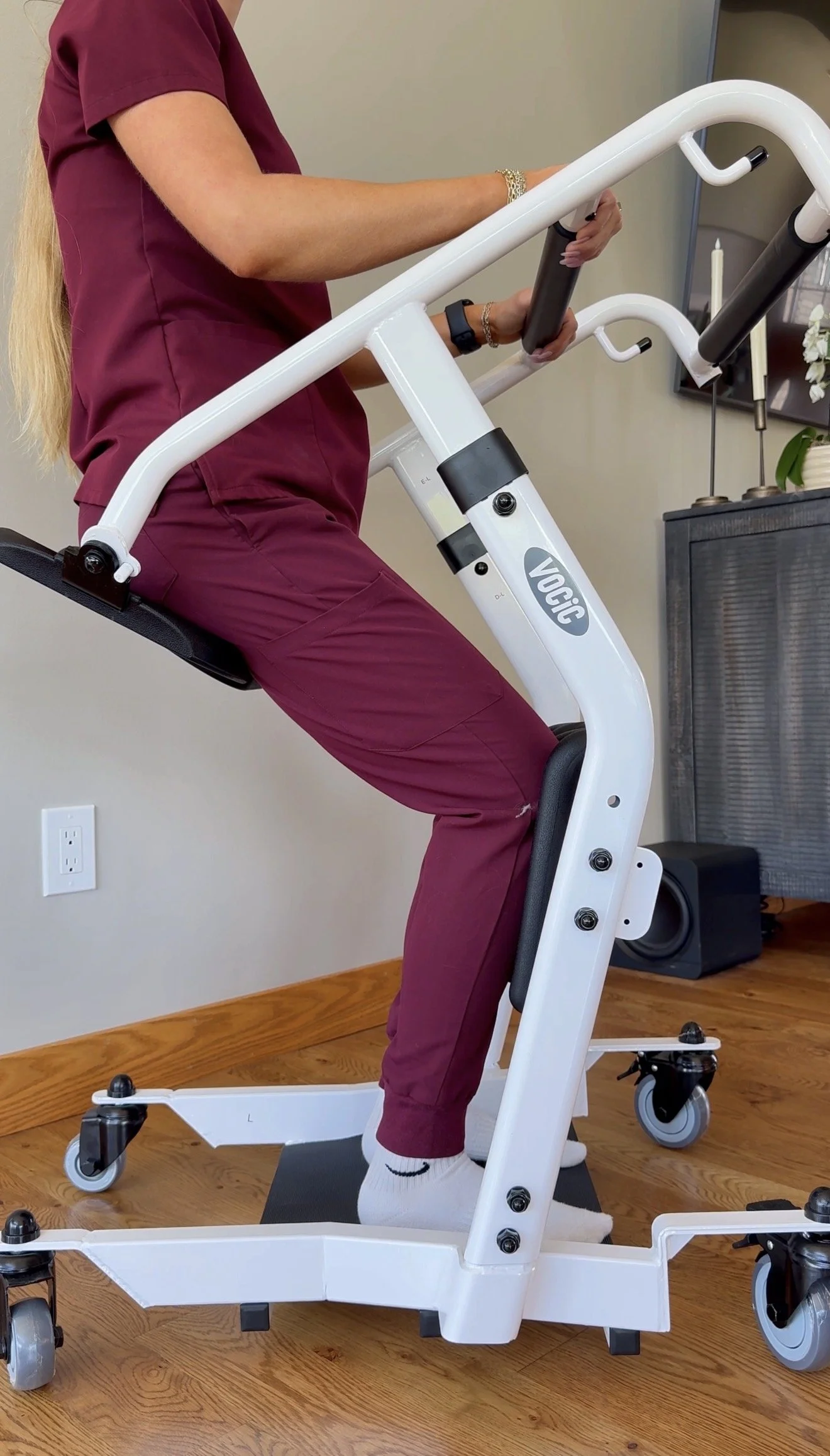
Walk into nearly any skilled nursing facility, hospital, or rehabilitation setting and you'll likely find a sit-to-stand device tucked away in a corner. Most clinicians are familiar with using these devices to assist with transfers for individuals who cannot safely stand or pivot independently.
But what if I told you that the sit-to-stand device can be much more than a transfer aid?
As an Occupational Therapist working with older adults, I frequently utilize sit-to-stand devices not only to facilitate safe mobility but also as a therapeutic intervention to address strength, balance, endurance, and functional participation.
Why Use a Sit-to-Stand Device as a Therapy Tool?
Many patients have the physical capacity to participate in standing activities but lack the balance, confidence, strength, or endurance to do so safely without support.
A sit-to-stand device provides a controlled environment that allows patients to practice standing activities while reducing the risk of falls. This creates opportunities to challenge performance and promote recovery that may otherwise be difficult to achieve.
By decreasing the amount of physical assistance required from caregivers, therapists can focus on providing skilled interventions that target functional outcomes.
Therapeutic Activities You Can Perform in a Sit-to-Stand Device
1. Repetitive Sit-to-Stands
Sit-to-stands are one of the most functional strengthening exercises available.
Using the sit-to-stand device allows patients to practice repeated transitions from sitting to standing while receiving the support they need to be successful.
Benefits include:
Improved lower extremity strength
Increased transfer independence
Enhanced motor planning
Improved confidence with standing
2. Anterior Weight Shifting
Many patients demonstrate a fear of falling or difficulty shifting their weight forward during transfers.
The sit-to-stand device provides an opportunity to safely practice anterior weight shifting while promoting:
Improved transfer mechanics
Increased trunk control
Better postural alignment
Reduced retropulsion
This foundational movement pattern directly translates to functional mobility and transfers.
3. Mini Squats
Mini squats can be incorporated to strengthen the quadriceps, glutes, and lower extremities while improving weight acceptance through the legs.
The support provided by the device allows patients to perform multiple repetitions with greater confidence and safety than they may be able to achieve unsupported.
4. Weight Bearing Through the Lower Extremities
Weight bearing is essential for maintaining strength, joint integrity, circulation, and overall function.
For patients who spend extended periods sitting or who are hesitant to stand, the sit-to-stand device provides a safe opportunity to encourage symmetrical weight bearing through both lower extremities.
This can be particularly beneficial for individuals recovering from illness, hospitalization, or prolonged immobility.
5. Standing Tolerance Training
Standing endurance is often a limiting factor for participation in everyday activities.
Patients may tolerate standing for only brief periods due to weakness, deconditioning, or fear.
The sit-to-stand device allows therapists to gradually increase standing duration while monitoring posture, fatigue, and activity tolerance.
Improved standing tolerance can directly impact a patient's ability to participate in self-care, meal preparation, and household tasks.
6. Dynamic Standing Balance Activities
One of my favorite ways to use a sit-to-stand device is for standing balance interventions.
Activities may include:
Reaching for cones
Retrieving objects outside the base of support
Crossing midline
Functional reaching tasks
Simulated household activities
Because the device provides external support, patients can safely challenge their balance while minimizing fall risk.
7. Standing ADLs at the Sink
Occupational therapy is most meaningful when it directly connects to daily life.
The sit-to-stand device can be utilized to facilitate participation in grooming and hygiene activities such as:
Brushing teeth
Washing hands
Washing face
Hair care
Shaving
This allows patients to practice standing during real-life occupations while simultaneously addressing strength, endurance, balance, and postural control.
The Occupational Therapy Perspective
One of the most valuable aspects of the sit-to-stand device is its ability to bridge the gap between impairment-based exercises and meaningful occupations.
Rather than viewing the device solely as a transfer tool, therapists can leverage it to create opportunities for functional participation while addressing underlying deficits.
When used creatively, the sit-to-stand device becomes a platform for:
Functional strengthening
Balance training
Endurance building
Neuromuscular re-education
ADL performance
Confidence building
Final Thoughts
The next time you reach for a sit-to-stand device, consider how you might use it beyond transfers.
By incorporating therapeutic activities such as weight shifting, standing tolerance, balance training, lower extremity strengthening, and standing ADLs, you can transform a piece of transfer equipment into a powerful rehabilitation tool.
Sometimes the best therapy interventions don't require new equipment—they simply require a new perspective.
